

By Noel Crack and Jeff Price
The suggestion was first raised by Noel Crack quoting as his source "The Wars of The Bruces - Scotland, England and Ireland 1306-1328" by Colm McNamee. The evidence is persuasive without being conclusive. Perhaps you might find the battle site by following these clues.
The map below shows the routes taken by the raiding Scots in 1319. Some of the evidence for the places on these routes may be less than certain because they are identified from the vills exempted from the Lay Subsidy of an eighteenth of 1319 and the damage could have been as well caused to those vills in the raids of 1318 as in the raids of 1319. However the key evidence for the battle under consideration is tied down to 1319.
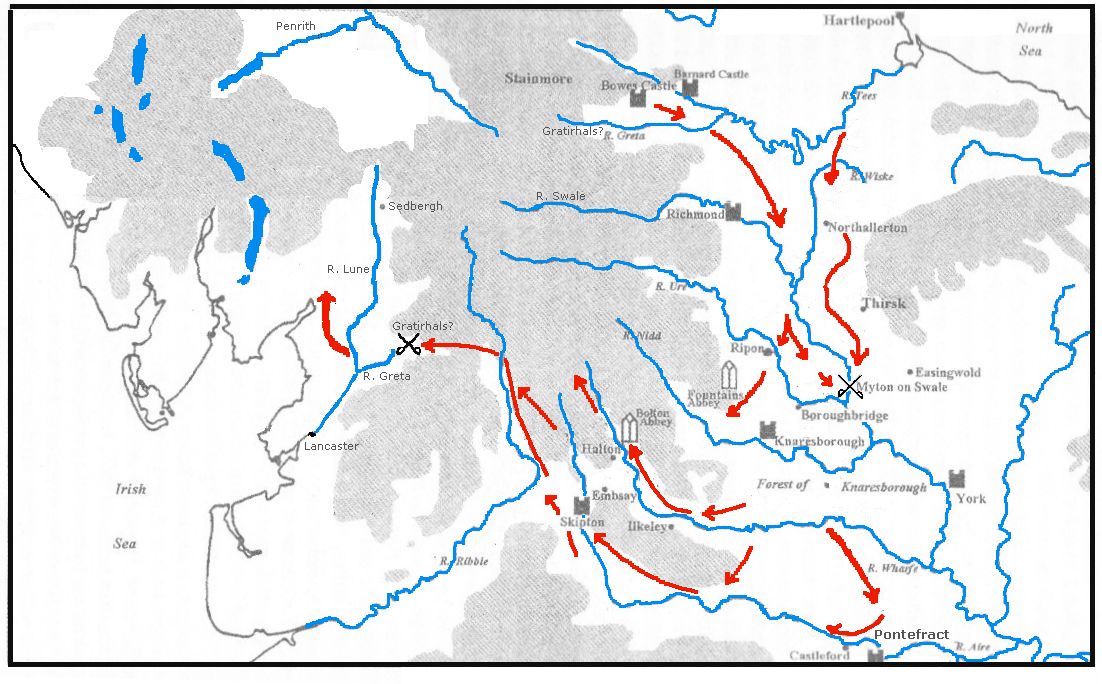
In 1319 there is evidence that Robert the Bruce intended a raid on York with a two-fold purpose - relieving the pressure of the besieging English on the Scots who held Berwick and at the same time the political stroke of capturing Queen Isabella who was in York in the summer of 1319 together with the English administration. Happily the Queen escaped to Nottingham before the Scots arrived at York. Unhappily the inept Edward II sent the militia from York to Berwick to assist with the siege leaving the hapless citizens and clergy of York to be slaughtered by the Scots near Boroughbridge. The Scots were then free to rampage throughout Yorkshire returning to home through Northwest England, some via Lonsdale and some via the valley of the Greta which gives us the possible site of the battle in Chapel-le-Dale.
The source for the account of the battle is the fourteenth century Historia Aurea by John of Tynemouth, which is largely concerned with the lives of Irish saints. Although this source dates the battle to 1318 other sources for the route of the returning Scots clearly fix the battle in 1319. This is what the Historia Aurea has to say of the Scots' journey in 1319:
"In returning homewards through western parts of England, they [the Scots] were set upon by a throng of Englishmen at Gratirhals, a very narrow ['strictissimum' in the manuscript] pass. But the Scots prevailed and the English were scattered, and many were killed, including Sir Henry Fitz Hugh, and they returned with great rejoicing to their own country taking many knights and squires with them." (English Historical Review xliii , p209 in V.H.Galbraith "Extracts from the Historia Aurea and a French Brut". The original manuscript is in Lambeth Palace.)
The term "Gratirhals" refers to the valley of the Greta. However there are two possible candidates for this River Greta - one flowing west to east from Stainmore through Bowes Forest into the River Tees and the other our very own river flowing through Ingleton. Whilst it is true that the Ingleton river makes more sense for the returning band of Scots (see the map,) it is still conceivable that there was a group of Scots returning via Stainmore who were ambushed. Colm McNamee states that Sir Henry Fitz Hugh held Bowes Castle from the Earl of Richmond to reinforce this point (and Sir Henry Fitz Hugh was in fact Keeper of Barnard's Castle in 1317 see Calendar of Close Rolls 1313-18, p 416). However what Colm McNamee does not state is that this same Sir Henry Fitz Hugh was the direct descendant of Alice de Staveley the daughter and sole heiress of Adam de Staveley. Sir Henry Fitz Hugh as a result held the vills of Ingleton and Bentham as well as Dent and Sedbergh. Ingleton, Twistleton, Burton and Bentham vills were all listed as exempt from the lay subsidy tax of 1319 as a result of burning by the Scots (but see the cautionary note above.)
The name "Gratirhals" is Norse derived. The boundary perambulations referred to in other places on this website are very dependent for their location on the ground on the interpretation of the Norse "hals" and there is a strong Norse influence on place names in our area. In contrast around Bowes' River Greta there is far less evidence of Norse influence in place names.Another point is that the terrain around Bowes River Greta does not provide any site which could be identified with "a very narrow pass" whereas Chapel-le-Dale near Weathercote Cave certainly fits that particular criterion. The River Greta at Ingleton now seems at least as likely as that at Bowes as the location for this battle.
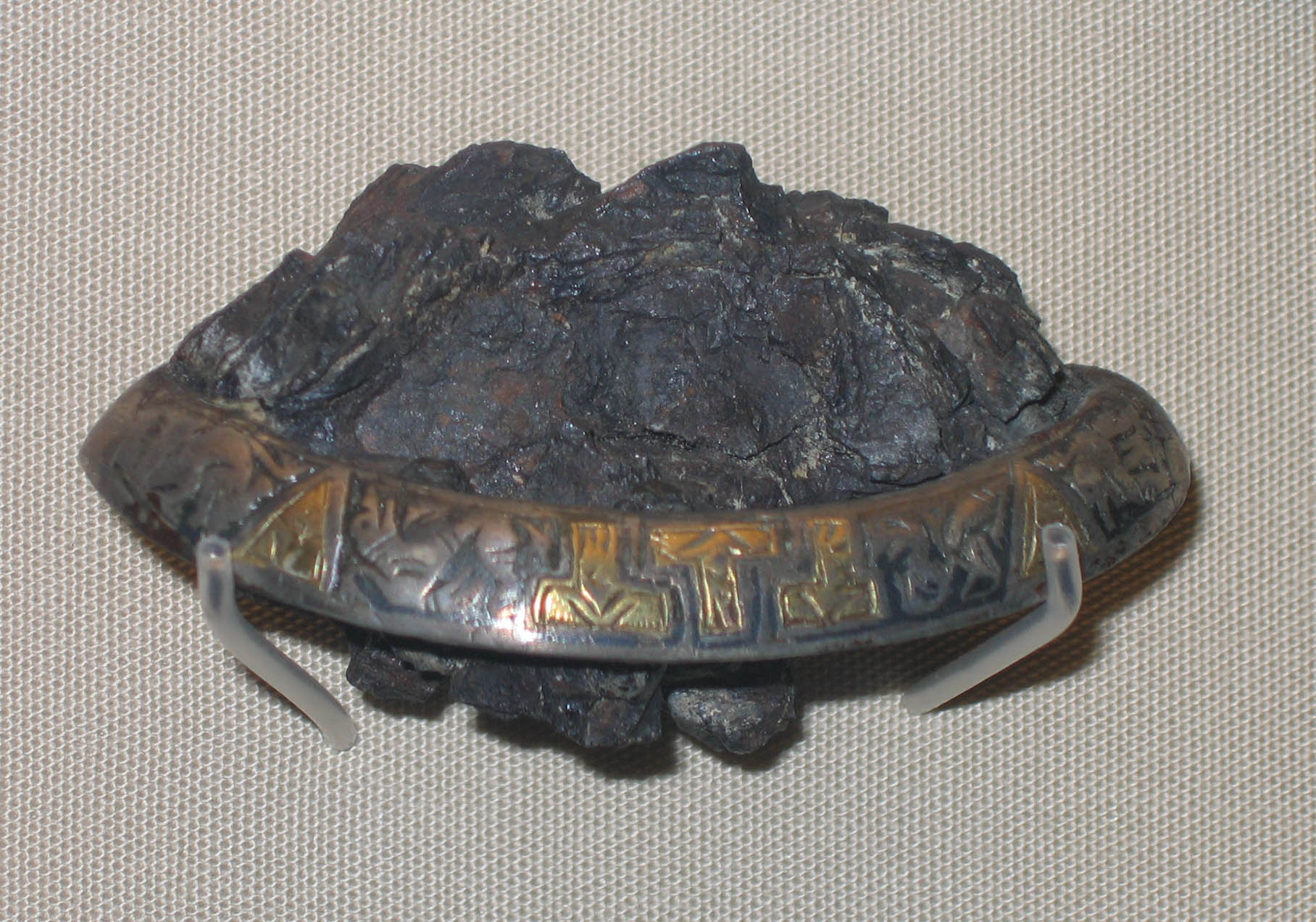
The "narrow pass" referred to in the account also fits the bill for a band of Scots who rampaged through Horton in Ribblesdale and then passed via Twisleton to Lonsdale on their way homewards through the West.We would judge that the balance of probabilities lie in favour of the battle taking place somewhere along the old Roman road from Chapel-le-Dale. In fact near Twisleton Dale House there is a perfect spot from which to launch such an ambush. Near to this spot in the 1940's the engraved silver sword pommel shown below was discovered during a rabbiting expedition as confirmed by Alec Tomlinson, the son of Harry Tomlinson who was a member of that rabbiting party. The pommel looks to have come from an earlier era than the 1300's but given the quality of the engraving that sword may have been handed down through the generations. That is speculative but it is strange that such an important and valuable item should have ended up where it did.
This battle does not seem to have been recorded in any of the modern literature dealing with the local history of the Ingleton area. Nor is it mentioned in disputes and court proceedings between local tenants and lords of the manor over tenant rights in the sixteenth and seventeenth centuries which hinged on whether the tenants had the greater rights of tenure that went with the obligation to military service. Forefathers who had fought at Chapel-le-Dale would have been a strong argument for the tenants to use as evidence of their provision of military service in the past. Interestingly the tenants won their case but lost the war with the Lowthers and their successors as lords of the manor - the rents were racked up anyway!
So was there a Battle of Chapel-le-Dale in 1319? What do you think?